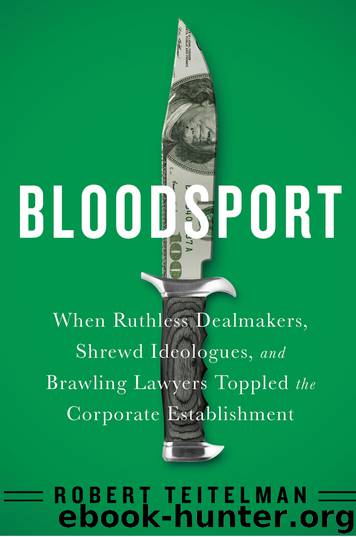
Bloodsport by Robert Teitelman
Author:Robert Teitelman
Language: eng
Format: epub
ISBN: 9781610394147
Publisher: PublicAffairs
Published: 2016-02-24T16:00:00+00:00
Chapter Twelve
THE FLAW IN THE PERFECT MACHINE
MILKEN’S SPECTACULAR EMERGENCE was the deus ex machina that Chicago needed to counter the poison pill. Milken swung the advantage back to offense. He defibrillated the Chicago dream of takeovers as a cleansing process of arbitrage back to life. The fact that Milken was a one-man market for junk bonds, which was hardly the way efficient free markets worked, was conveniently overlooked, at first through lack of knowledge of how Drexel operated, then, for true believers, more deliberately, and long after Allan Sloan in Forbes, Connie Bruck in Predator’s Ball, James Stewart in Den of Thieves, and various federal investigations had produced detailed views of Milken’s machinery. But in 1985 Milken not only provided a potent new fuel for the takeover market, he was, his advocates declared, democratizing takeovers, both by selling bonds of formerly downtrodden companies and by financing swarms of raiders, many of whom had been obscure or marginal in the past. (Some of them, to be fair, built considerable empires.) Milken was the deity the theory demanded. Again, the fact that he “democratized” takeovers only for those buyers who he personally allowed into his club was not apparent or part of his growing reputation. Eventually he would lose control of determining that membership—Wall Street was already scheming to break his stranglehold—and the jig would be up.
Milken was the triumph of ends over means—of reality bending toward desire. He kept the means under a large blanket as long as he could. But it wasn’t just the mounting tension between his near-absolute control and an exploding market. Milken refused to allow his deals to be seen to fail. The ultimate source of his power was the belief that he knew more, that he was smarter, that he had many options to deal with distress, loss, or bankruptcy. Milken seemed infallible. So great was this power that Chicago viewed Drexel and Milken as models for effective private restructurings that avoided the bankruptcy courts. But the Chicago crowd did not spend a lot of time trying to figure out how those restructurings were actually accomplished. Milken made it seem as if he never lost, or that his deals never flopped. They did; he was just a master at burying failure and moving on. And as long as the market and the economy grew, he could continue to play that game.
Still, one potential problem always lurked at the edges of the takeover market. Shareholders might be strolling off with fat premiums, making event studies appear spectacular. But what was happening within those merged or acquired companies? What long-term effect—and event studies, measures of abnormal stock gains in takeovers, were, by definition, short-term—did M&A have on the resulting companies? Did the question of success and failure end at a deal’s closing party, and involve only a new owner and a higher share price? Over the short term, Milken and his raiders appeared to be omnipotent forces. But some observers had their doubts. They knew that markets rose and fell, and that the turn often came with shocking, even destructive speed.
Download
This site does not store any files on its server. We only index and link to content provided by other sites. Please contact the content providers to delete copyright contents if any and email us, we'll remove relevant links or contents immediately.
Hit Refresh by Satya Nadella(9109)
When Breath Becomes Air by Paul Kalanithi(8408)
The Girl Without a Voice by Casey Watson(7871)
A Court of Wings and Ruin by Sarah J. Maas(7789)
Do No Harm Stories of Life, Death and Brain Surgery by Henry Marsh(6924)
Shoe Dog by Phil Knight(5241)
The Rules Do Not Apply by Ariel Levy(4943)
A Higher Loyalty: Truth, Lies, and Leadership by James Comey(4937)
Hunger by Roxane Gay(4913)
Tuesdays with Morrie by Mitch Albom(4753)
Everything Happens for a Reason by Kate Bowler(4722)
The Immortal Life of Henrietta Lacks by Rebecca Skloot(4566)
Millionaire: The Philanderer, Gambler, and Duelist Who Invented Modern Finance by Janet Gleeson(4448)
How to Change Your Mind by Michael Pollan(4338)
All Creatures Great and Small by James Herriot(4295)
The Money Culture by Michael Lewis(4174)
Man and His Symbols by Carl Gustav Jung(4116)
Elon Musk by Ashlee Vance(4110)
Tokyo Vice: An American Reporter on the Police Beat in Japan by Jake Adelstein(3966)
